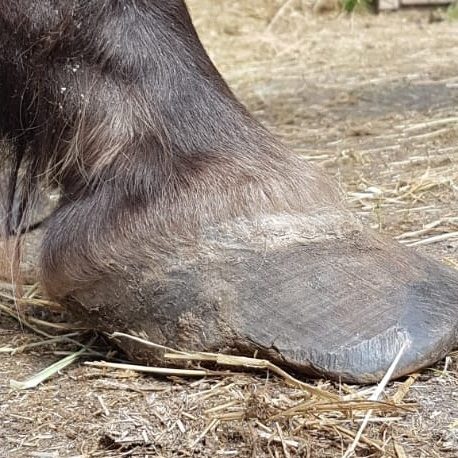
Photo Guide: How to get the best results
To ensure a precise AI analysis of the hoof's mechanical load, please follow these steps carefully:
1. Preparation
- Clean the hoof: Remove dirt, mud, or loose bedding. The hoof wall and the transition to the coronet band must be clearly visible.
- Firm ground: Place the horse on a flat, level, and hard surface (e.g., concrete or asphalt). Avoid grass or deep sand.
- Square standing: Ensure the horse is standing "square" (weight distributed evenly on all four legs).
2. Camera Positioning
- Level with the hoof: Do not take the photo from a standing position. Hold your phone/camera at hoof height (ground level).
- Side View (Lateral): Position the camera exactly 90° to the side of the hoof. The camera should point directly at the center of the hoof wall.
- Front View (Frontal): Position the camera directly in front of the hoof, centered on the toe.
3. Quality Check
- Focus: Ensure the image is sharp and not blurry.
- Lighting: Avoid strong shadows or direct sunlight hitting only parts of the hoof. Bright, indirect daylight is best.
- Distance: Keep enough distance so the entire hoof and the area just above the coronet band are visible, but stay close enough to see details.
Pro Tip: If the horse has long hair (feathers) covering the coronet band, please pull it up or secure it briefly so the transition from skin to horn is visible.
Warum diese Formulierungen?
- "Coronet band": Das ist der Fachbegriff für den Kronrand. Das ist für deine Analyse wahrscheinlich der wichtigste Referenzpunkt.
- "Square standing": Das ist der Fachausdruck dafür, dass das Pferd mit allen vier Beinen gleichmäßig belastet und gerade steht.
- "Lateral / Frontal": Diese Begriffe sind auch für Laien im Englischen gut verständlich, klingen aber professionell und technisch präzise.